
Framing Far-Right Politics as a Trauma Response
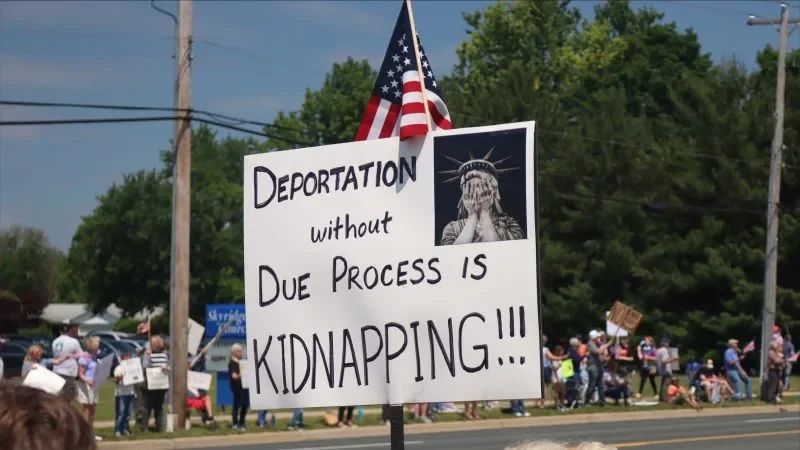
Has anyone else been noticing a huge shift in the political landscape?
I recently did a live-reading on my TikTok, where one of the messages that came out was about how the main two parties are starting to fragment and new alliances across party lines are starting to form.
(Image source: KTLA 5)
It also got me thinking about how the far-right has historically been very resistant to change, so why is it now the time for us to understand it from a higher perspective? It’s because we are in The Age of Aquarius!
The astrology promises that radical change is inevitable. Politics are not excluded in that change, in fact when astrologers often reference major cycles, they use political and social revolutions as indicators of key trasits. The silos we once found comfort in are cracking opened to reveal a deeper, more wholistic truth.
Here are a couple of Astrologers who are speaking on these transits and revolutionary changes:
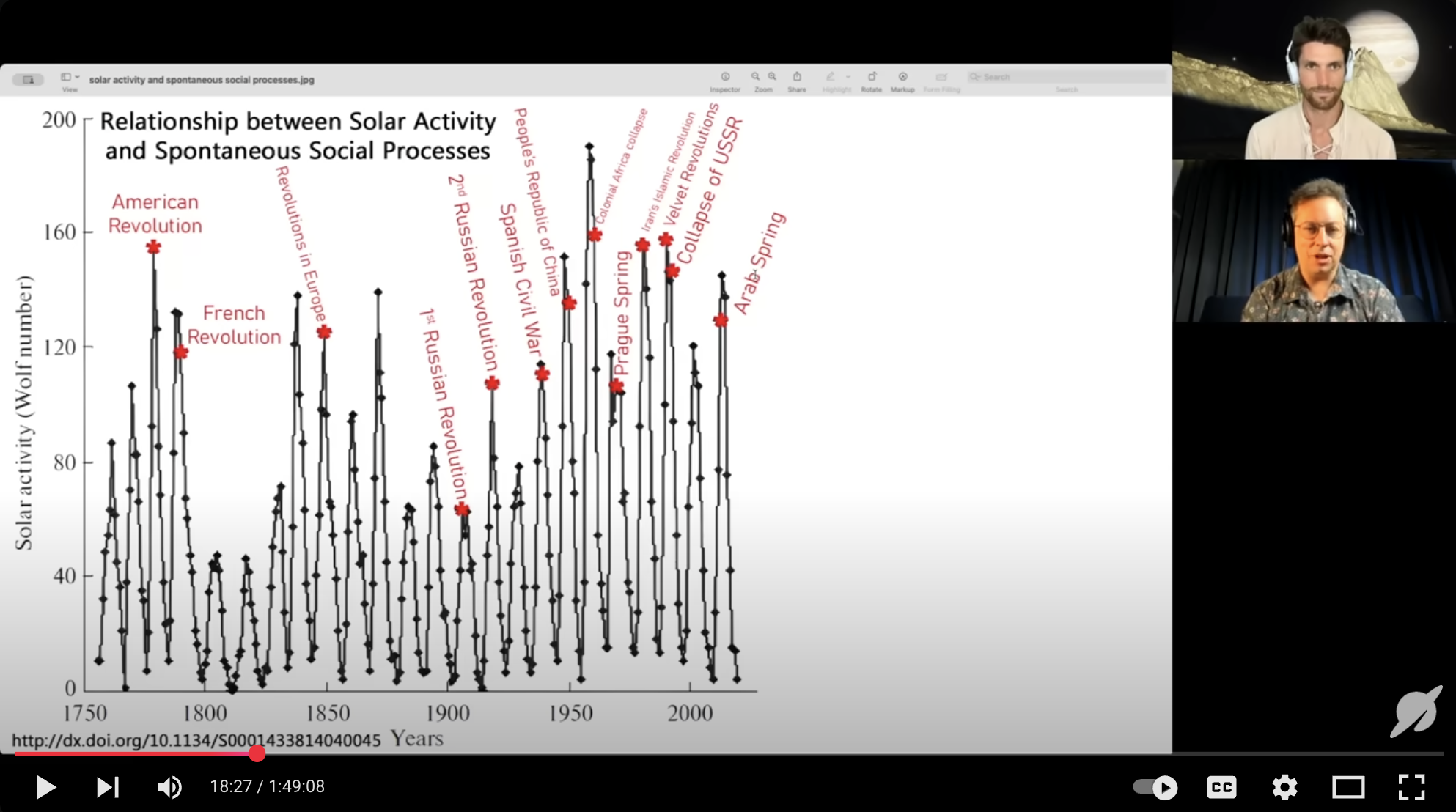
Here’s a screenshot of a graph they reference at 0:18:19 showing the correlation of solar activity and spontaneous revolutions. Go watch it, it’s fascinating!
As someone who has historically identified with left-leaning views, I’ve been reflecting deeply on the possibility that the politics of the Far-Right might actually be a form of trauma response. This raises important questions about the origins of such beliefs and behaviors. If this is true, then how should we approach and strategize our resistance to it in a way that acknowledges this underlying pain?
We tend to think of fascism and far-right extremism as political ideologies as products of blatant ignorance, hatred, or miseducation. And sure. They are…
But what if that’s not the whole story?
What if the rise of authoritarianism, white nationalism, and xenophobia is a collective trauma response?
Not just an intellectual failure, but an aspect of the collective nervous system gripping tightly to a past it can’t let go of?
I am starting to see it as a soul-wound misfiring, expressing itself as an ideology.
Let’s be clear: this doesn’t excuse it. Violence, racism, or fascism is amoral, period! But if we want to transform these patterns and not just react to them, then we have to understand what’s driving them beneath the surface.
And this also doesn’t mean that the left isn’t without their own wounds and trauma. There are trauma responses on both sides, but I believe that there is more symptoms that are causing the most problems from the far-right (and perhaps you’d agree with that given our current state of affairs in the US being ushered in by the far right and their leaders.)
"Progress"=Trigger; Collective Pain=Wound
For many far-right supporters, “progress” is experienced not as liberation but as loss.
Loss of identity, status, familiarity, certainty, worldview, coherence, etc.
Entire communities gutted by economic change, cultural shifts, or automation — all while being told that these changes are for the greater good.
And you’d imagine that the natural result is one is that a deep and unspoken grief, unprocessed. It also often goes unnamed, unseen, and unresolved. And like all unprocessed grief, it curdles. Distorts and hides itself as it reaches for certainty. It finds someone to blame…
….and Fascism and other far-right talking points offers just that.
Each promises belonging and a mythology that makes the pain make sense.
This isn’t just political. It’s emotional. It’s primal. It’s shadow psychology that tells us, ‘until we make the unconscious conscious it will direct our lives [and our country!] and we will call it fate’ -Carl Jung
Collective/Individual Trauma seeks Control
Individually, trauma drives us to control what feels unsafe. It keeps us in fight-or-flight. It clings to black-and-white thinking. It avoids ambiguity because ambiguity feels dangerous.
The same is true on a societal level. (Coping mechanisms exist at both levels!)
When entire populations feel displaced by change (economically, culturally, etc) they may turn toward ideologies that promise order, purity, restoration, and a return to the golden age AKA “the way things used to be.”
In this light, the far right becomes a kind of nostalgic nervous system: grasping backward toward an imagined safety, even if that safety was only ever an illusion built on domination.
Reacting to Reactivity Isn’t a Way Out
Here’s something to chew on: IF far-right politics is a trauma response, THEN reactivity will not heal it.
Just like with an individual facing deep trauma, others who might shame, mock, or scream back at them doesn’t open their heart, it actually only confirms and strengthens the threat.
That doesn’t mean we stay passive or quiet. IS there a way to resist without reacting in the same thinking or energetic frequency that created the trauma in the first place?
For example, if it was chronic invalidation that caused this, then more invalidation will only make things worse in the long run.
While this sentiment is pretty common-knowledge, unfortunately, its rarely practiced. (It feels much more cathartic to react / fix / manage / lecture the problem).
Here’s what I know to be true:
➡️Reactivity creates more reactivity.
➡️Unprocessed pain reinforces unprocessed pain.
➡️Trauma, if unmet with loving presence, gets retransmitted.
Education is great, but NOT enough
This one is a hard pill to swallow for most of us on the left. We think if we just educate others hard enough then we will ‘win’. But that is NOT how it works.
Not to say education isn’t important or great as a tool, but that it’s just not enough.
We have to also interrupt the cycle from a trauma-informed perspective. We know that from psychology: knowledge of the trauma doesn’t always equal healing. (So why do we think it’ll be different in the collective sphere of trauma?)
Here’s what it could look like to move towards healing:
Refusing to dehumanize the wounded while still holding strong boundaries
Creating spaces of belonging that don’t rely on scapegoating other victims of the system
Learning to grieve the worlds we’ve lost, and the myths we must let go of
Building trauma-responsive movements, not just intellectually righteous ones that rely solely on cold frameworks and principles.
Doing our own shadow work, so we don’t meet fascism with a mirrored rigidity and enable more of the same to perpetuate.
Healing isn’t only soft and fluffy. It’s rigorous. It asks of us to commit to the struggle of a lifetime, a multigenerational longview of healing and liberation— one that stretches far before we were born and will go on long after we pass.
Where to Begin: Inroads for Exploration
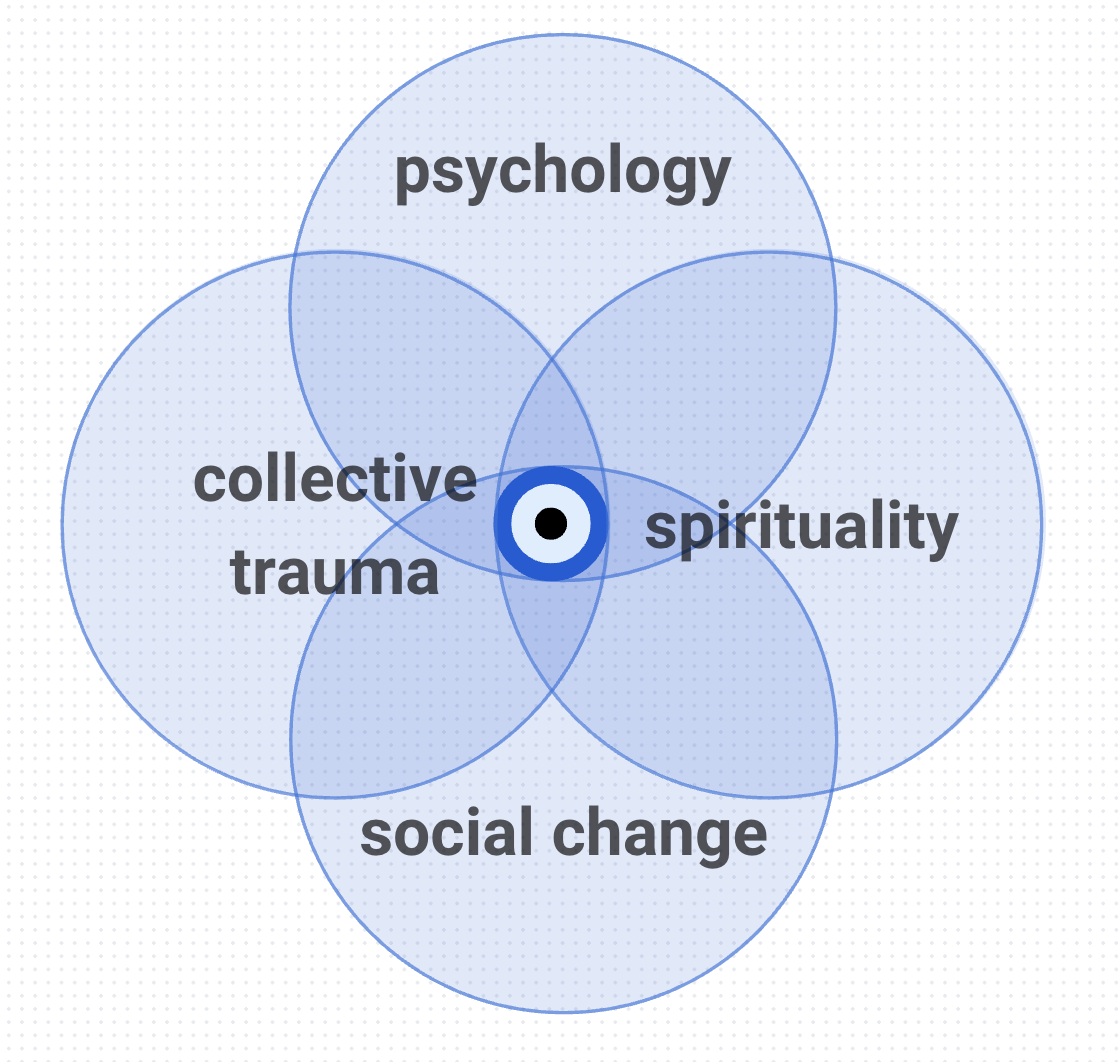
This is an emerging field…
It lives in the liminal space between industries and defined spaces. But it already has quite a growing number of practitioners, thinkers, scholars, and visionaries who are exploring the crossroads of collective trauma, social change, psychology and spirituality.
Click-to-expand the row⤵️ for more resources:
-
Thomas Hübl – Talks about “collective trauma fields” and how societies carry frozen pain across generations. His book Healing Collective Trauma is a powerful entry point. (Although his work is solid having been to his webinars, I do have to warn: Thomas has a pro-zionist worldview, so proceed with caution)
Resmaa Menakem – In My Grandmother’s Hands, he brings the wisdom of somatic healing to racialized trauma, inviting us to understand white body supremacy as a trauma response embedded in the nervous system.
Dr. Jennifer Mullan – Her work, Decolonizing Therapy, is leading a global movement that is radically reimagining the old mental health paradigm away from colonial mindsets and methods and moving towards a decolonized practice.
Frantz Fanon – Known for his autobiography Black Skin, White Masks; French West Indian psychiatrist, political philosopher, and Marxist from the French colony of Martinique. His works have become influential in the fields of post-colonial studies and critical theory. His insights on society, psychology, and race reveal frameworks to understand and heal oppression.
Further reading about Intergenerational Healing: Healthline article. -
Arlie Russell Hochschild – Her concept of the “deep story” in Strangers in Their Own Land explores how emotional narratives shape political beliefs, especially in conservative communities.
Lauren Berlant and Sara Ahmed – Both examine how affect and identity become entangled with politics, often revealing hidden grief or loss beneath ideological alignment.
-
Mariame Kaba, Adrienne Maree Brown, and many others offer frameworks for healing harm without replicating punitive systems — emphasizing that justice and healing must walk hand in hand.
Explore transformative justice, community accountability, and restorative practices for models that address harm as a symptom of deeper wounding.
-
John Paul Lederach – A peacebuilder who writes about the “moral imagination” needed to transform cycles of violence by understanding the pain beneath the power struggle.
Truth and Reconciliation processes, especially those in post-conflict societies like South Africa, Rwanda, or Northern Ireland, for models of large-scale healing and truth-telling.
Dare Not Linger: The Presidential Years (2017) where Nelson Mandela recounts that historic process in detail and with plenty of complexity and nuance that doesn’t flatten “peace.”
-
Somatic practitioners and therapists working at the nexus of trauma, justice, and embodiment (e.g. Staci Haines, Prentis Hemphill) offer insight into how healing becomes political, and how political work must be felt in the body.
Organizations like Healing Justice LDN is an “evolving framework that invites us to interrupt and intervene in interpersonal, structural, and intergenerational violence for the sake of just and health-filled futures.”
🤔...so what now?
We should always call out bad actors, while remaining vigilant of the larger picture. There IS a way to be firm against these issues we are currently seeing (i.e. ICE raids, authoritarianism) without dehumanizing those who are actively reacting to collective trauma. It does sounds like a dance that is very fraught, but it’s actually natural for the soul. The soul can see the truth of harm without judgement or dehumanizing. It see the sacred in all beings.
The temptation is always to react with polarization. We tend to weaponize blame and shame when we feel helpless and hopeless. BUT if you’re drawn to this work, we must stay rooted in courage, humility, and deep listening. If you’re drawn to me and my spiritual work, you’re likely being called to hold paradox, sit with discomfort, and move from reaction to embodiment.
When it comes to healing in the fore-mentioned arenas, much of this work is still emerging. Cross-industry leaders and folks on the ground are finding innovative ways to collaborate to heal the collective.
If you want a place to start, start by finding your role in this work:
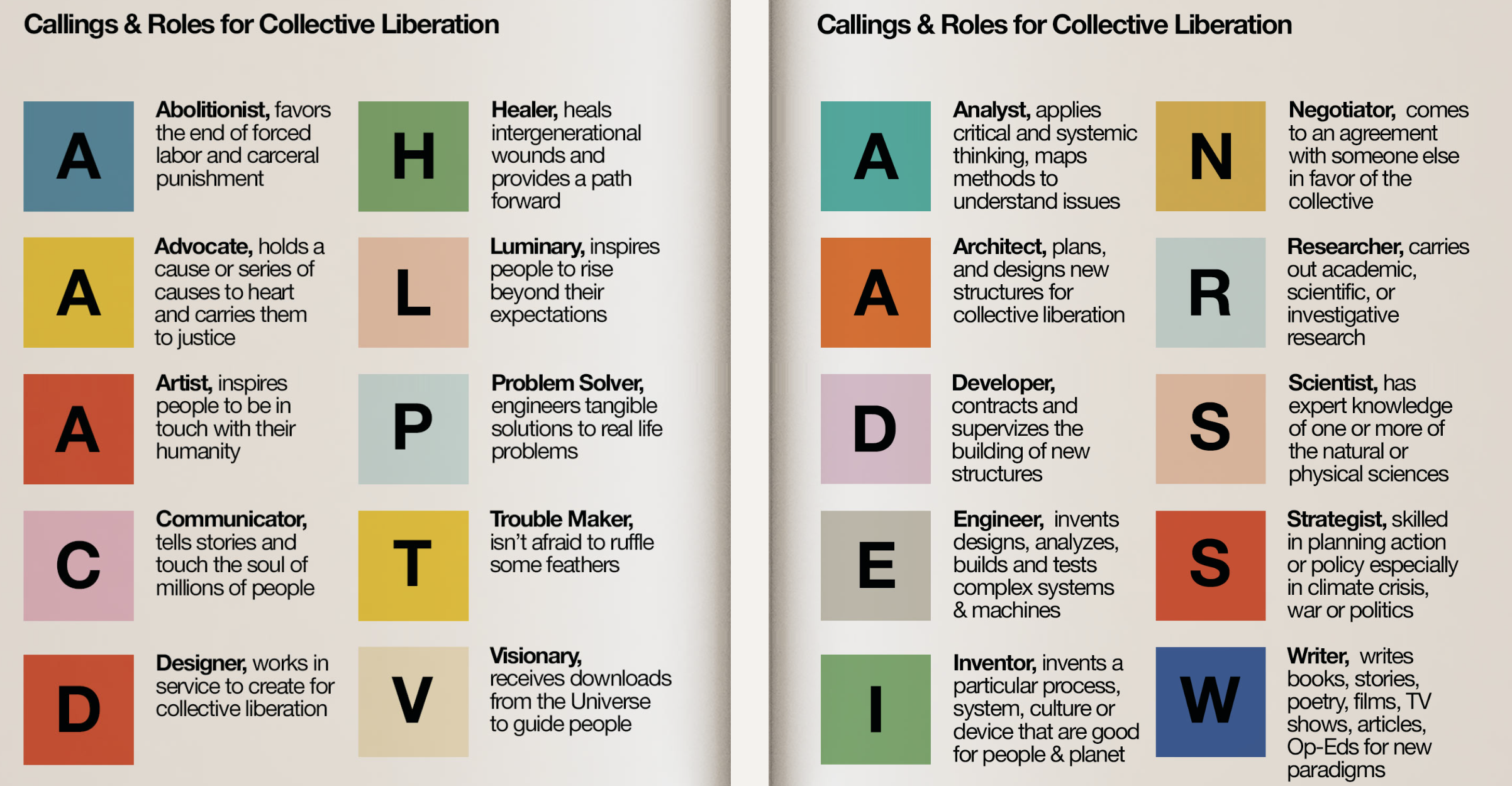
Image Source: Slow Factory https://slowfactory.earth/roles-for-collective-liberation
Find your role(s) in this work, then find others to collaborate with. Is here is room for any opportunities to make a ripple, combining forces and strengths? What communities are you already a part of? What spaces are you already tapped into?
Don’t just read the roles as a personality test, move it into action. Take it to the streets, transmit it into a project by taking the roles that resonate and creating a project for the collective wellbeing.
Take the bootstrap mindset and leverage what you already have, starting with where you are and a network you’re already plugged into.
If you are looking to find a collaborator in this space you can get in touch!
If you’re looking for a space to realize a project and build it from the soul? Check out the Intuition Project Lab and let’s work together to help you build it.
Leveraging our privilege, gifts and talents for collective liberation is one of the MOST fulfilling things we can do at these times of great upheavel. The best part? You can start right now to help heal generations of pain, trauma and unprocessed grief.
Sincerely,
Christina