
Why Resolutions Fail: The Hidden Influence of Attachment Styles on our Goals
This is part TWO of a series on hacking your new years resolutions. This one is about Attachment styles!
In 2026 we have mostly gotten over the cultural taboo around therapy. Thank god!!!
YET, it still isn’t widely known what Attachment Styles are, and how they shape almost everything we relate to. Attachment theory helps us understand the foundational blueprints for our relationships and our need for safety.
Attachment styles do not only apply to relationships with other humans. That’s one misconception! They also shape how we relate to more abstract areas, like our relationship with money, with our relationship to our health and our bodies, with our hopes and dreams, and with the commitments we make to ourselves.
Quick recap: Briefly recall the powerful idea from Part One: We're always in either a Virtuous Cycle (where actions create positive momentum) or a Vicious Cycle (where struggles lead to more struggle).
In this post, I help you move from the mechanics of a cycle (explained in part 1) to the deeper psychological engines that drive them. This is a more ‘meta’ cycle that describes our relationship to safety and connection..which are CORE HUMAN NEEDS by the way!
So without further adu, let’s (1) identify how your default attachment style might be affecting your resolutions and (2) give you super specific and tailored strategies for your default attachment style along the way.
If you don’t know what your attachment style is, read this (article) and you can take their free online quiz
The Foundation: Survival Patterning & Attachment Styles
There’s often a Missing Piece of the puzzle when talking about resolutions. This shows up like us intellectually knowing how to build virtuous cycles and what they could/should look like, conceptually. Then, WHY is it still so damn hard?
To answer this question, we have to get under the hood of the psyche. The psyche iceberg that is.
Here’s the short answer: Because our blueprints for relationships and safety—our attachment styles and survival patterns—directly influence how we approach goals, face setbacks, sustain effort/capacity over time and perceive reality. As you know, survival and attachment go hand-in-hand, as both are tied to our subconscious mind and the most limbic part of our brains. These are the aspects of our brain wired for survival.
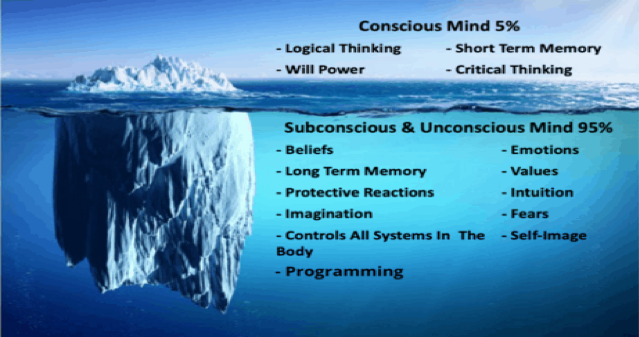
This is the psyche iceberg I always reference in my tiktok videos #IYKYK
Survival Patterning: Our brain's ancient, automatic programs for staying safe (fight, flight, freeze, fawn). Under stress (like the challenge of a resolution!), we all default to these responses to manage. These responses include…
Fight: "I must conquer this goal or else..!" (Leads to burnout).
Flight: "This is too hard, I'll just find a new goal/obsession." (Constant shifting).
Freeze: "I'm overwhelmed. I'll just procrastinate" (Paralysis).
Fawn: "What do you think I should do?" (Loss of intrinsic motivation).
Attachment Styles (The Relationship Blueprint): Simplified overview of how our early caregiving shapes our view of self, others, and challenges.
Secure: "I am capable, and support is available." Approaches goals with calm persistence, usually sees setbacks as feedback, not an indictment.
Anxious-Preoccupied: "I need validation to know I'm okay." May tie self-worth to goal achievement, fear "falling behind," seek constant reassurance.
Avoidant-Dismissive: "I must be self-reliant and not need anyone." May resist asking for help, see goals as purely solitary endeavors, disconnect from the "why."
Fearful-Avoidant/Disorganized: "I want success but fear getting hurt or failing." A push-pull with goals intense start, then sabotage or retreat due to internal conflict.
Hey Attachment, meet Cycle!
Building a Virtuous Cycle Through Each Lens:
Secure: Naturally builds sustainable cycles. Their challenge is maintaining them amidst life's chaos. Strategy: Use their innate trust to create flexible systems.
Anxious-Preoccupied: Can create cycles fueled by anxiety, which leads to burnout.
Tailored Strategy: Build "reassurance checks" and "process praise" into the cycle. Prone to the overemphasis on external validation from others and gets sidetracked by expectations of others. Focus on consistency over dramatic results. Use a coach or buddy for calm accountability, not intense policing.
Avoidant-Dismissive: Tendency is to create rigid, isolated cycles that lack emotional fuel. Prone to running when things get hard or when there’s a roadblock.
Tailored Strategy: Connect the goal to a deeper, personal value (not just external metrics). Practice small acts of asking for help or sharing progress to build support into the cycle.
Fearful-Avoidant: Tendency is to start out very strong then break the cycle abruptly and are notorious for push-pull dynamics that fuel drama to excerbate their tendencies towards self-blame and self sabotage. Fear of failure + the shame that comes with it, or even fear of success might be at play!
Tailored Strategy: Focus on microhabits (day-by-day, not year-long!). Practice self-compassion as a non-negotiable part of the cycle. Join or create a "safe to fail" environments where you celebrate effort, not just accomplishments. Have other activities/outlets to support the emotional experience that comes with the inevitable challenges (i.e. art therapy, life coaching, hanging out with friend, etc.)
How Styles Fuel Vicious Cycles:
Anxious: one missed day ➡️ "I'm a failure" shame spiral ➡️ give up.
Avoidant: challenge arises ➡️ "I can't rely on anyone not even myself" ➡️ overwhelm ➡️ quietly quit on yourself
Fearful: make progress ➡️ fears success or failure ➡️ self-sabotage ➡️ back to square one
These are awful to read but even more awful to live out on repeat…
Attachment Distorts Our Perception of Setbacks
Our attachment style doesn't just influence our actions; it creates a powerful perceptual filter for challenges and failures. A truly neutral occurrence, like missing a workout or exceeding a budget, is rarely seen as neutral. Instead, it's interpreted through the lens of our core relational beliefs and our nervous system state.
For the anxious style, a setback screams: "See? You're failing already. You're not worthy." It becomes proof of inadequacy which can drive overcompensation or hustle that leads to burnout.
For the avoidant style, a challenge whispers, "This is why you can't try new things. Now you're exposed." It becomes self-fulfilling proof of the danger.
The fearful-avoidants (FAs) style might hear a chaotic mishmash "This is too much, pull back!” But “I hate that I want this... but what if I’m wrong" The obstacle throws you in an inescapable catch 22.
Even the secure style isn't immune, but their filter is more accurate: "That didn't work. I'm disappointed, but let's see what went wrong." A setback is information, not who you are. Noticing this is the first step to overcoming the ‘failure.’ And if it feels especially painful, a securely attached person may shift into insecure attachment style temporarily. If you are secure it helps to know which insecure style you tend toward when things gets extra hard. In which case, see the remediation for that style!
Distortion, Meet Remeditation!
Perception Remediation for the Anxious
Practice the Pause. Then Fact Check. When a setback triggers a shame spiral ("I'm a failure"), pause. Then intentionally take time to reflect and write down the objective fact ("I ate takeout tonight instead of cooking") and then consciously separate it from the emotional story. And do this until it becomes a habit.
Perception Remediation for the Avoidants
Run a Audit when a challenge feels like proof you must [fill in the blank], and I should just quit while I’m ahead, ask: "Is needing to figure this out truly a weakness, or is it just part of being human?" Reframe seeking advice or help like using a tool.. not as a failure, but as a strategic use of resources.
Perception Remediation for the Fearful-Avoidants (FAs)
Implement the "Pause & Ground" Protocol. When an obstacle triggers the internal push-pull (a surge of desire followed by an urge to sabotage), physically pause. Don't act. Breathe. Name the warring parts: "Part of me wants to push through, and part of me is scared and wants to quit." This simple act of observation creates a tiny space between the impulse and the action, weakening the distortion.
Perception Remediation for the Securely Attached
Model "Curiosity over Catastrophe." Consciously adopt the question: "What is this obstacle here to teach me about my approach?" This framing nips the distortion in the bud, and redirects energy toward innovative problem-solving and continuous learning.
In all these cases, the point is to move away from personalizing the failure into data-analysis of the problem and get as quickly to becoming the solution (rather than beating yourself up)
How to Make Accommodations
Step 1: Identify Your Default Become aware of your tendencies and pre-existing patterns. This will help you do step 2 & 3…
Step 2: Design Your Virtuous Cycle with Your Style in Mind.
If you lean Anxious: Build in structured self-compassion breaks. Set time in the morning or end-of-day to recalibrate and check in with yourself to give yourself validation along the way.
If you lean Avoidant: Intentionally build in disruptions for the urge to run, avoid, escape or isolate. Add one small collaborative element (a class, a social media post, a mentor) to encourage you to stay the course.
If you lean Fearful (FA): Prioritize safety first and build on tiny wins. Make your first step super small it cannot fail. Celebrate showing up, not just results. Build in celebrations and positive reinforcement. You might need extra support and that’s ok. Keep going anyways!
Step 3: Reframe Your Support System. Choose accountability partners, tools, and communities that counterbalance your style's pitfalls
Anxious types need quality time for themselves without feeling guilty or self-indulgent. They also need calm supporters who will validate them and cheer them on. Avoidant types need low-pressure communities that celebrate them no matter their accomplishments, and are simply happy they showed up at all. Fearful (FAs) likely need a mix of both!
Conclusion - From Surviving to Thriving
Like I noted earlier in part one, our resolutions aren't just about willpower. Subconscious Patterns eats willpower for breakfast!
Infact, the key reason whyresolutions usually fail is because the goals (and the changes required) are not in concert with our deepest subconscious, nor have we understood our own patterns and how to work to reprogram them. By understanding our attachment style, we can design virtuous cycles that are resilient and adapts to our best and worst tendencies.
The ultimate virtuous cycle is this: Self-awareness leads to tailored action, which leads to small wins, which builds a more secure sense of self, which makes the next cycle easier..
It might actually help to reframe that you are not just building a better habit; you're building a deeper well of capacity for your nervous system where you are consciously choosing the internal scripts and subconscious programs that ultimately shape your reality. You are building safety and security from within, and enabling your highest potential to thrive.
Now I want to hear from you!
Reflect: Which part of this breakdown resonated with you the most? What did you learn about your attachment style?
Experiment: Pick one tailored strategy and apply it to a current new years resolution or goal. Tell me how it went! I want to hear about it!
Optional: Get extra support interrupting your loudest pattern. This can be joining a support group working towards similar goals, a safe friend/community, hiring a trusty mentor/coach or a licensed therapist..Ask yourself: what am I willing to commit to so I can set myself up for success this year?
I hope this was helpful and best of luck with your resolutions!
Christina
—
P.S. Ready to go deeper? If so, I’m here to support you on your journey of makign the most of this year. Book your free 1:1 chat here for next steps, if you want to work together. Let’s go!!