
The Ancient Practice of Mentorship and what’s been Lost to Modernity
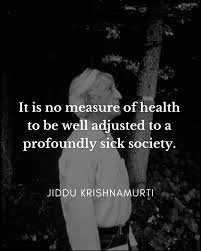
I’ve been feeling an inner discrepancy I couldn’t quite name but it was a weirdness I felt about the mentorship and coaching industry at large. It’s something I’ve intuitively felt for a long time but at first, I thought it was just me. Or maybe my imposter syndrome, or the usual overwhelm of running a business. I guessed it probably had to do with capitalism too (ya know, the usual suspects hah) but I couldn’t get to the deeper why.
But the more I sat with it, the more I realized: it’s grief. Grief for something most of us have never experienced but can somehow still feel the absence of.
The Krishnamurti quote keeps me up at night, and it perfectly speaks to what I’ve been experiencing. It also reminds me that this isn’t a personal failing—it’s an appropriate response to participating in something fundamentally broken. The discord I feel within isn’t because I need to internally ‘adjust better’ to how this industry works. It’s because the industry itself is a part of the profoundly sick system, and my intuition is trying to tell me something about it.
A story I had chatgpt help me write because I was at a loss for words.
..and if you know me, I usually have a fat stack of metaphors ready to go. I pride myself in this but this time as I was writing about this topic, I was coming up empty so I resorted to asking ChatGPT. I had chat tell it back to me as story.
Here’s what it responded with which reads sort of like a parable:
There was a time when the village had weavers who worked in a long house at the center of town. The house had large windows on all sides so light came in at every hour, and the looms were arranged so the weavers could see each other work.
Young people who wanted to learn and they simply started coming around to volunteer. First they would sweep the floors and wind the bobbins. They’d watch how the master weaver’s hands moved, how she chose colors, how she fixed mistakes. They’d listen to the weavers talk while they worked—not lectures about weaving, just the ordinary conversation of people doing something together.
Eventually someone would say, “Here, try this,” and push a small loom toward the young person. The learning happened in the rhythm of daily work. When you got stuck, help was three feet away. When the master weaver got old, her hands cramping, the others took on her commissions while she told them what she knew.
The cloth they made held the village together—literally.
Wedding blankets, burial shrouds, baby slings. You knew who made each piece. The weavers knew what their cloth would be used for.
Then “efficiency” was introduced when the town suddenly experienced an unexpected tourism boon.Slowly but surely the weaving house became a furniture and textile store. The looms were sold and manufacturing was off-shored to another industrial town.
The weavers were no longer needed at the weaving house.
But people still wanted to learn the craft, thus a new digital market emerged. Former weavers started offering Weaving Mentorship Programs. Six weeks, learn the fundamentals. Video calls where they’d watch an instructor weave through a screen and say encouraging things.
Some were great teachers, genuinely trying to pass something on. But something was missing and everyone could feel it.
Ok end scene.

What’s lost when we lose the Weaving House?
Real mentorship was never meant to exist in isolation.
When I say “real” I don’t mean what we have today isn’t real (because at least it does still exist) but rather the kind that had existed for thousands of years before the modern version of it became a commodified digital marketplace.
Here’s the tea: Mentorship was always part of a larger ecology of belonging.
There was physical proximity over time. You can’t learn pottery from A.I. or someone you see on Zoom twice a month. You learn by being in the studio with mud smeared all over your apron while watching the teacher’s hands and how they work with the clay. You see what they do when something goes wrong, absorbing their rhythm and attention. You observe them troubleshooting in realtime.
Daily life was shared. Mentors weren’t just disembodied talking heads. They were as human as we were: they also lost their keys. They also mismeasured things. You saw how they handled conflict with others that pushed their buttons, how they rested, how they talked to fellow weavers and onlookers, what they prioritized in a time crunch. The teaching wasn’t just the explicit lessons—it was entire kinestetic modeling of a lifestyle and way of being.
There is mutual interdependence within a ecosystem.
The mentor needed help with the work, the apprentice needed to learn. There was real reciprocity, not just “I paid you for your expertise so give me the best hacks already…”
Within community, is communal accountability.
Everyone knew everyone. Your reputation mattered because there was social fabric holding the relationships. Not just zoom calls that disappeared into the void of cyberspace
There was intergenerational mixing and mingling.
Village of Elders, peers, and beginners, all learning from each other, all held and holding up the same relational fabric.
There was time measured in years and lifetimes, not weeks. Breakthroughs weren’t the goal, they were the natural progression of being in proximity. There was a sacred bind that deepened through repetition and seasons, through failure and repair and trying again.
No money needed to hold up the contract. Just priceless interdependence, mutual wellbeing, trust, communion. And mentorship happened to be woven into all of it.
—
When I study my favorite academics, historians, scholars, artists, and thinkers they, too, had mentors who shaped their work. Carl Jung learned from his mentor Sigmund Freud. He expanded Freud’s model of the unconscious mind, which became the foundation of their work and legacies.
But those weren’t three-month containers. They were years-long sometimes decades worth of interconnected networks of relationships embedded in communities of practice, in lineages that stretched backward and forward through time.
Though Jung later broke with Freud, that split was a turning point for the entire school of psychology and psychotherapy. Textbooks now note how their division opened new paths for understanding the inner world and our psyche. Even their conflict became the basis for budding ideas and innovation that later helped my own healing journey decades later.
Heck, even Jesus had mentors. John baptized him in the Jordan and learned the Torah from teachers in the Levant. Then he walked dusty roads with his disciples for years. They ate together, slept in the same spaces, watched him teach and heal and get frustrated and pray and do it all again the next day. The teaching *was* the relationship, the shared life, the physical proximity.
A hunger hard to even name
Here’s what I think is happening: People are starving for belonging, purpose, contiunity, village-like community and lineages to learn from and contribute to.
Instead we say Something’s missing. Something’s wrong. I need clarity.
The mentorship/coaching and self development industry has become extraordinarily skilled at leveraging this hunger. And that’s on the optimization of The Free Market™️.
But belonging, purpose, and lineage can’t be sold. They can’t be packaged in an online course. They emerge from conditions the market has no interest in creating because those conditions aren’t scalable or profitable.
But the *language* of belonging, purpose, and lineage? That sells like hotcakes.
So we get “join our community” when it’s really just a Slack channel.
“Find your purpose” is really about crafting your unique selling proposition.
“Step into your legacy” when it means building a personal brand.
“Find your people” when these are get-clients-quick schemes.
The marketing speaks directly to our deepest human needs…and then delivers solutions that don’t quite satiate that hunger but make the longing worse.
If you crave a home-cooked family meal with loved ones around, but instead got talked into buying a protein bar with a picture of a family eating dinner on the wrapper…you would be justified in feeling conned.
The protein bar might have some nutrients. It might even satisfy the hunger. But it’s not the thing you’re truly wanting. And the worst part is that it uses the imagery of the thing to sell itself, which makes the whole thing all the more cruel.
Then what’s left?
When that kind of coherence and cohesion is lost, what’s left is alienation dressed up as personal empowerment.
What’s left is credentials to tee-up in a CV.
Information without formation.
What’s left? people who are competent but unmoored, skilled but unsure what they’re even longing for. And underneath all of it is this haunting sense that something is supposed to be here…but isn’t.
I also don’t think the answers are as simple as ‘we just need community!’ or ‘we just need more third spaces!'… Even though we deserve these things (they should be inherent and free!)
I’m just saying we might’ve even lost the capacity to be in right relationship with those things—things we can’t even quite name.
We’ve been formed by systems of extraction, efficiency, speed, transaction, and competition as our default operating system. It’s deep in our subconscious of how we perceive time, relate to purpose, learning, accountability, community and so on.
We might need to first see that learning isn’t disconnected knowledge but emerges from being embedded in relationship to others, to the earth, to a lineage of belonging with. But perhaps I’m also guilty here.
Complicit
I’ve used words like “transformation” while setting up automations and writing “nurture sequences.” This is the matriarchal vocabulary of care. But when it gets formatted for the patriarchal logic of extraction, it becomes flattened into a cold, lifeless thing.
I’ve done it too… because I must live in this system. What’s that quote again about ‘no ethical consumption under capitalism’?
But I can’t pretend anymore that “nurture” sequences and nurturing the human spirit are the same thing. I can’t pretend that my mentorship is the ecosystem.
The map is indeed NOT the territory.
Here’s what I can offer…and what I can’t
I’ll start with what I can’t do: I cannot restore what’s been systematically dismantled over generations.
I can’t rebuild the village alone. I can’t dismantle the current forces of harm and alienation.
And there’s a certain sadness in recognizing that. But it keeps humble to the trap of thinking I have to single-handedly save or fix everything.
What I CAN do is refuse to participate in the forgetting.
I can name what’s been lost.
I can create and grow within the current confines while envisioning a more hopeful world built on care. I can tell the truth about limitations. I can offer you a space to grow and expand and explore the gold within you on the spiritual path..and do so on your own terms.
And while I can’t give you all the answers to the profoundly sick society, i CAN walk alongside you on this path. I want to celebrate wins with you. I want to work together with you towards you goals. I want to empower and activate your most aligned and intuitive Self to come online…and maybe then, only then, can we get closer to a profoundly healthy society.
Remnants and Remembrance
There’s an ecological term for this: remnant
A remnant is what’s left of an ecosystem after most of it has been destroyed. Its the small patch of old growth forest in a clearcut landscape.
Here’s the thing: Remnants can’t restore the whole system alone.
BUT they do hold the seed of promise and encodes a bit of the memory. They preserve the species and relationships that might, someday, be able to rise again to their fullest glory.
Maybe what I’m doing is remnant work. Keeping the practice alive, holding the memory, showing what it could look like, creating small spaces where the ancient ways are still relevant.
That hopefully matters not because it will change the industry, but because some people will find those remnants and remember something they’d forgotten. They’ll experience a different way. They’ll know it is, in fact, possible. And maybe they’ll be inspired to cultivate their own small patch of old growth.
Still here?
If you’ve read this far and something in you is saying yes, this, I feel this too—then maybe you’re an old soul like me. And/or you are one of the ones ready to remember.
I’m here because I believe there are others who feel this same inner conflict, people searching for new, gentler ways to relate to their practice, those who wish to re-member their wholeness rather than dis-member themselves for the marketplace.
My offerings are far from a silver-bullet solution or system. This year, i’m dedicated to being part of the experiment in doing so together.
The weaving house had windows on all sides so light poured in at every hour.
Maybe we can’t rebuild that yet. But we can notice the cracks where light is coming through.
Best,
Christina
P.S. Thanks for reading!
If you want to explore or check out all my services including mentorship with me, click here.